Phoenix Hit and Run Accidents — What to Do and Your Legal Rights
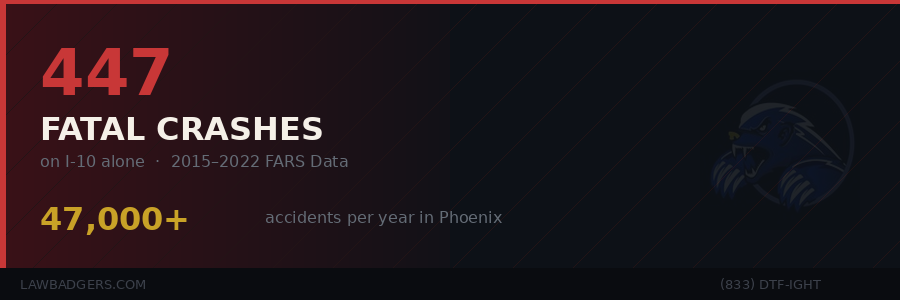
Phoenix has a massive hit-and-run problem. Our analysis of Phoenix Police Department calls-for-service data reveals approximately 20,000 hit-and-run incidents per year — nearly half of all traffic accidents in the city. If you’ve been the victim of one, here’s what you need to know.
What Is a Hit and Run?
A hit and run occurs when a driver involved in an accident leaves the scene without stopping to identify themselves or render aid. Under Arizona law, this is a crime. A.R.S. § 28-661 requires drivers involved in accidents resulting in injury or death to stop, exchange information, and render reasonable assistance. Failing to do so is a Class 2 felony if someone was seriously injured, or a Class 3 felony if someone died.
Even in property-damage-only accidents, leaving the scene violates A.R.S. § 28-662 and is a Class 2 misdemeanor.
What to Do Immediately
Don’t chase the other driver. It’s tempting, but it puts you at further risk and could complicate your case. Instead:
- Get the license plate — even a partial plate helps enormously. Snap a photo if you can.
- Note the vehicle description — make, model, color, any distinctive features like damage, bumper stickers, or custom rims.
- Call 911 immediately — report it while details are fresh.
- Look for witnesses — other drivers, pedestrians, or nearby businesses may have seen the vehicle.
- Check for cameras — many intersections in Phoenix have traffic cameras, and nearby businesses often have security footage. Ask police to check.
- Document your injuries and vehicle damage — take photos from every angle.
How to Recover Compensation
Even if the hit-and-run driver is never identified, you may still be able to recover compensation through:
Uninsured Motorist (UM/UIM) Coverage: Your own auto insurance policy may include uninsured motorist coverage. In Arizona, insurance companies are required to offer UM/UIM coverage, though you can decline it in writing. If you have it, this coverage pays for your injuries and damages when the at-fault driver can’t be found or has no insurance. This is exactly why we recommend every Arizona driver carry UIM coverage.
If the Driver Is Found: When police identify the hit-and-run driver — and they often do through cameras, witness tips, or physical evidence like paint transfer — you can pursue a claim directly against the driver and their insurance. The fact that they fled the scene often supports a claim for punitive damages on top of your actual losses.
Why Hit and Runs Happen in Phoenix
Phoenix’s wide, high-speed arterial roads contribute to the problem. Our data shows the most dangerous surface streets — Indian School Road, McDowell Road, 19th Avenue, 43rd Avenue, and Broadway Road — are also where hit-and-run incidents concentrate. Many involve impaired or uninsured drivers who flee because they’re afraid of criminal consequences.
The Statute of Limitations Still Applies
Even in hit-and-run cases, Arizona’s two-year statute of limitations under A.R.S. § 12-542 applies. The clock starts on the date of the accident. Don’t wait to get legal help — evidence disappears quickly, and camera footage is typically overwritten within days or weeks.
What an Attorney Can Do
A Phoenix car accident attorney can help you file your UM/UIM claim, work with police investigators to identify the driver, subpoena traffic camera and business surveillance footage, and calculate the full value of your claim including medical bills, lost wages, and pain and suffering.
The Law Badgers have handled numerous hit-and-run cases in Phoenix. We know how to work the system to get you compensated — whether the other driver is caught or not.
INJURED? GET A FREE CONSULTATION.
The Law Badgers fight for maximum compensation. No fee unless we win.
Call (833) DTF-IGHT