The Dangers of Distracted Driving in Phoenix
Car accidents are one of the leading causes of death and injury in the United States. Every year, over six million crashes occur nationwide, resulting in millions of injuries. And distracted driving is one of the biggest culprits — the NHTSA estimates that distracted driving kills over 3,000 Americans annually.
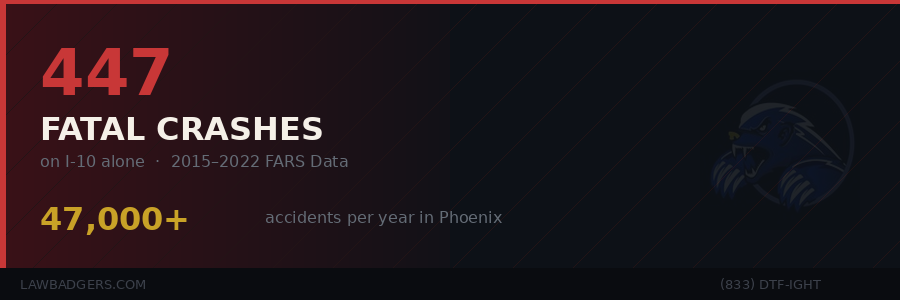
In Phoenix, our crash data shows 379,090 traffic accidents from 2018 through 2025. A significant portion of those are caused by drivers who weren’t paying attention.
What Counts as Distracted Driving?
Distracted driving falls into three categories:
Visual — taking your eyes off the road. Looking at your phone, adjusting the GPS, turning to talk to a passenger.
Manual — taking your hands off the wheel. Reaching for something, eating, drinking, adjusting controls.
Cognitive — taking your mind off driving. Daydreaming, intense conversation, emotional distress.
Texting is the most dangerous because it combines all three. Sending a text takes your eyes off the road for an average of five seconds. At 55 mph, that’s the length of a football field driven blind.
Arizona’s Hands-Free Law
Arizona passed its hands-free law in 2019 under A.R.S. § 28-914. It prohibits using a handheld wireless communication device while driving, including texting, browsing, and talking without hands-free technology. Violations are a civil traffic offense — $75 to $149 for a first offense, $150 to $250 for subsequent offenses.
More importantly for injury victims: a violation of Arizona’s distracted driving law constitutes negligence per se — meaning the distracted driver is automatically considered negligent if their violation caused the accident. This significantly strengthens your personal injury claim.
Proving Distracted Driving
Even without a citation, distracted driving can often be proven through cell phone records showing calls, texts, or app usage at the time of the crash, witness testimony that the driver was looking down or holding a phone, data from the driver’s phone showing screen activity timestamps, surveillance or dashcam footage, and the accident reconstruction itself — rear-end collisions with no braking, for example, strongly suggest inattention.
Your attorney can subpoena phone records and app data during litigation to prove the other driver was distracted.
What to Do If You’re Hit by a Distracted Driver
Follow the standard accident checklist: call 911, document the scene, get medical attention. If you saw the other driver on their phone, tell the responding officer. Note whether the other driver appeared distracted — were they holding a phone, looking down, not braking before impact?
Then call the Law Badgers. Distracted driving cases often carry the potential for enhanced damages because the behavior is so reckless and preventable.
INJURED? GET A FREE CONSULTATION.
The Law Badgers fight for maximum compensation. No fee unless we win.
Call (833) DTF-IGHT